About Me

I am married to my loving husband for more than 45 years now. I am a mother to 3 beautiful children, until years ago when I lost my youngest son. Since then my life is forever altered but yet unbroken....

Saturday, 19 February 2022

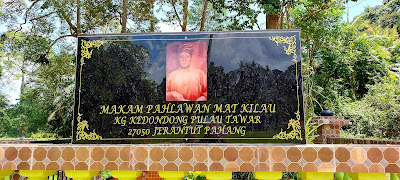
Makam Pahlawan Mat Kilau, Pahang

“The bad news is time flies. The good news is you’re the pilot…” – Michael Altshuler
 
(The makam is very well maintained)

GPS: 3.882171,102.420478
03°52′55.82″N 102°25′13.72″E

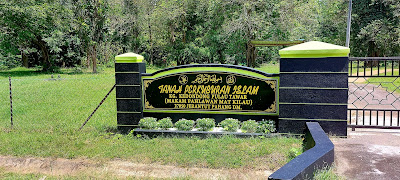
A short drive from Masjid Lama Pulau Tawar we came to a Muslim Cemetery in Kampung Kedondong where Mat Kilau was buried.

(Tanah Perkuburan Islam Kg Kedondong)
(A short drive from Kg Pulau Tawar)
(Ample parking space by the roadside)
(We used a side entrance to the mausoleum)
(A brief history of Mat Kilau)
(Old graves in the cemetery lot)

Mat Kilau was born in 1865/1866 in Kampung Masjid Pulau Tawar, Jerantut, Pahang during the reign of Sultan Ahmad Al-Muadzam Shah. His full name is Mat Kilau bin Imam Rasu @ Tok Gajah. His mother was Mahda, the daughter of Tok Kaut Burau. Mat Kilau is good at reciting the quran, berzanji and berzikir maulud as well as learning berzikir rebana. Mat Kilau's hobby is to play spinning tops and always the champion in his village.

(The makam is situated in the far corner)
(A nice tiled wall surrounding the tombs)
(A simple monument for a warrior)
(Paying our respect, Al-fatihah)

When he was about 20 years old, Mat Kilau married a girl named Yang Chik binti Imam Daud from Kampung Kedondong and was blessed with three children.

Mat Kilau is one of the famous Malay warriors who fought against the British colonialists in Pahang. He died on 16 August 1970 at the age of 104 years old, two weeks after he came out from hiding and declared himself as Mat Kilau.

(The tomb of Mat Kilau)
(He was once known as Mat Siam)
(A broken signage)
(Peaceful and quiet)

Masjid Pulau Tawar, Pahang – 1880

“Attitude is a little thing that makes a big difference…” – Winston Churchill

(Masjid Mat Kilau - Masjid Lama Pulau Tawar)

GPS: 3.877321,102.422764
03°52′38.36″N 102°25′21.95″E

Today we took time to drive to Pahang to track down the legendary Tanah Melayu hero, Mat Kilau.

Our first destination was Masjid Lama Pulau Tawar. The mosque became the focus of the entire Malaysian population in 1969 when the nationalist figure Mat Kilau appeared out of hiding to introduce himself to the world.

(A nice day for a long drive)
(Arriving at Kampung Pulau Tawar)
(Also known as Masjid Mat Kilau)

The existence of the old mosque is related to the history of Malay heroes, Tok Gajah, Mat Kilau, and their followers during resurgence of nationalism against the British colonialists in Pahang.

The construction of the old mosque was initiated by Imam Perang Rasu or better known as Tok Gajah, his son Mat Kilau, as well as the Malays of Pulau Tawar in the early 1880s. The old mosque was later given a new look in 1923 but retaining the traditional architecture using wood and bamboo from the local forest. According to history, Hugh Clifford, the British Resident, once landed on the river bank near the mosque to hold talks with Mat Kilau and Tok Gajah as well as the people of Pulau Tawar so as not to interfere in the affairs of the British administration in Pahang.

(The mosque is well maintained)
(A historical mosque) 

The old mosque underwent a few renovations and used cement flooring after it suffered severe damages after a flood. The kubah and mimbar of the mosque are still in the original forms which have the influence of Minangkabau architecture.

(The mosque is converted into a madrasah)
(Madrasah An Nabawiyyah Lid Dirasatil Islamiyyah)
(The mosque is used as class room)
(Students having their morning tea)
(A few shelters around the mosque)

Presently, Masjid Lama Pulau Tawar is converted into a religious school, Madrasah An Nabawiyyah Lid Dirasatil Islamiyyah. Several buildings and hostels were built around the old mosque for the use of the students. Close to the madrasah, there is a horse stable maintained by the students.

(TIRC - Tawar Island Riding Centre)
(The Madrasah's admin Office)
(New buildings around the mosque)
(The mosque is next to Sungai Pahang)

A newer Masjid Jamek Pulau Tawar situated on the main road a short distance away, is now used by the villagers for jemaah prayers to replace the Masjid Lama Pulau Tawar.

(The new Masjid Jamek Pulau Tawar)

Tuesday, 15 February 2022

Makam Sejarah Jelebu, Negeri Sembilan

"The act of forgiveness takes place in our own mind.It really has nothing to do with the other person..." - Louise Hay

(Makam sejarah is covered with lalang)

GPS: 02°55′09.15″N 102°04′54.86″E
2.9192085, 102.081905

The next place of interest was the historical tombs of the relatives of Moyang Salleh.

(Parking at the entrance)

The cemetery is located 3.2 km from the town of Kuala Klawang. The cemetery lot is a little unkempt and covered with tall grasses and weeds. There is nothing interesting in this tomb complex as there are no other monuments except old graves. There are tombs of grandparents and parents of the famous Moyang Salleh who is also the founder of the Luak institution in Jelebu.

(A large cemetery lot)
(Description and a brief history)

In the register of names of Jelebu's Undang or penghulu, the person recorded as the first penghulu was Tok Gombak who came from Pagar Ruyung Western Sumatra, then followed by Tok Mentunggang and Tok Moyang Salleh, the first Jelebu Undang to use the title of Datuk Mandulika Menteri Akhir Zaman, Sultan of Jelebu. The top two figures, Tok Gombak and Tok Mentunggang, have already used the title of Penghulu Jelebu.

(The old graves covered with grass and weeds)
(Identifications of the graves)

During the reign of Moyang Salleh around 1757, luak Jelebu was liberated from the Sultan of Johor. The Sultan of Johor awarded him the title of Dato Menduleka. He was the last minister of Sultan of Jelebu and he became the King.

A tomb was built to commemorate his struggle to liberate Jelebu. We did not visit the tomb of Moyang Salleh as it was raining cats and dogs.

Masjid Kuala Dulang, Negeri Sembilan - 1618

“Never let the fear of striking out keep you from playing the game.”– Babe Ruth

(Masjid Kuala Dulang, supernatural and mystical)

GPS: 02°55′56.24″N 102°04′48.24″E
2.93223, 102.08005

Our last visit for our Kembara Masjid today is Masjid Kuala Dulang.

(The signage on the wall)
(The weather was gloomy when we arrived)
(The missionaries disappeared after building this mosque)
(The mystery that is still the talk of the town)

Masjid Kuala Dulang is the oldest mosque in Jelebu, Negeri Sembilan. It is located in Kampung Kuala Dulang, 1.5 km from Kuala Klawang. The mosque was founded in the 16th century by two Muslim missionaries, Dato Nika and Mudim Khatib Raja. They also founded the village of Kampung Peninjau.

(A brief history of the mosque)
(The translation in Chinese, Japanese and English)
(The mosque is closed outside prayer time)
(Strict SOP during the pandemic)

In the beginning, the mosque was just a shed with thatch roofing. It was where the Muslim missionaries had sought shelter. More uniquely, this mosque was initially developed without the use of nails. Masjid Kuala Dulang is not only a mosque without a dome, it has a flat roof. The original thatch roof still remains today and is now used as the roof of the mimbar. The tabuh in the courtyard of the mosque is made of timber from the forest and cowhide. Its age is said to be the same as the age of the mosque. The geduk does not use nails and only uses pegs.

(The gate was locked)
(Taking photo from outside the gate)
(The corridor is spacious)
(The dos and don'ts during the Covid 19 pandemic) 
(The mosque will only open during prayer times)

According to old folk tales, it is said that a tray (dulang) filled with food had mysteriously appeared, and would continue to be filled with food no matter how often worshippers ate from it. The tray disappeared a few years after, as mysteriously as how it had first appeared after a person accidently dropped the tray and broke it.

(Riding the ATV around the mosque)
(The bridge across Sungai Batang Jelebu)
(The river will overflow during rainy season)

Another strange thing about the mosque was during two major floods in the 70’s where most villages were submerged except Masjid Kuala Dulang even though the mosque was located on the banks of Sungai Batang Jelebu. 

(An old graveyard on the higher ground)
(Odd large rocks as gravestones)

The original old mosque no longer exists as it has been renovated and upgraded to become a modern mosque. Probably the existing mosque is built on the same site as the old mosque.

The mosque is a popular tourist attraction, not only for the locals, but also visitors from outside Negeri Sembilan who often visit the mosque to perform nazar prayers, fasting and giving donations.

(A large oak tree near the graves)
(A stone with some illegible writings)
(The old mosque in the background)