About Me

I am married to my loving husband for more than 45 years now. I am a mother to 3 beautiful children, until years ago when I lost my youngest son. Since then my life is forever altered but yet unbroken....
Showing posts with label Attractions. Show all posts

Sunday, 6 October 2024

A tour of Tugu Negara...

"This nation will remain the land of the free only so long as it is the home of the brave..." - Elmer Davis

(Aira, Alia and Arif at Tugu Negara)

The visit to Tugu Negara was the first for Alia, Arif and Aira. Alia especially, was overly excited and intrigued by the history and controversies of this national monument.

The Tugu Negara is constructed to commemorates those who died in Malaysia's struggle for freedom, principally against the Japanese occupation during World War II and the Malayan Emergency, which lasted from 1948 until 1960.

Constructed in 1966, the sculpture that stands as a centerpiece of the monument is 15 meters tall, made of bronze and was designed by Austrian sculptor Felix de Weldon. The sculpture depicts 7 figures, 5 of the figures (1. holding the Malaysian flag, 2. armed with a rifle and bayonet (left), 3. armed with a machine gun (right), 4. soldiers tending to fifth wounded compatriot represents the victorious allied forces while the other 2 figures that lie on the ground represents that of the defeated communist forces.

In 1975, the monument suffered extensive damage due to an explosion. It has since been restored to its original state. A wreath-laying ceremony used to take place at the monument every 31 July on Warriors Day but the event was since moved somewhere else.

(A beautiful fountain at Tugu Negara)
(Kuala Lumpur skyline in the background)
(Was last here in 2010 with Hana)

At the entrance to Tugu Negara there is an interwar-era cenotaph originally erected by the colonial British administration near the Kuala Lumpur Railway Station. The cenotaph was intended to commemorate the Great War (1914–1918) and honour those from the British Malayan colonies who were killed in the war. The cenotaph's inscription would later include fallen British Malayan soldiers of World War II (1939–1945). Names of the fallen are engraved on plaques of the cenotaph as a tribute to their sacrifices. In 1964, the cenotaph was moved from its original location to the site of the National Monument in Lake Gardens.

(A brief history of Tugu Negara)
(The Cenotaph near the National Monument)

Saturday, 22 July 2023

Jetty Beting Beras Basah

“History is not the past but a map of the past, drawn from a particular point of view, to be useful to the modern traveller...” - Henry Glassie

(Jetty Beting Beras Basah)

Jetty Beting Beras Basah is located at the mouth of Sungai Perak in Bagan Datuk. Near the mouth of the river is a sandy beach area that can be seen when the tide occurs. The sandbar is not visible but a small flag on a wooden pole in the middle of the sea can be viewed by visitors from the viewing pavilion at the end of the beach.

(The junction leading to the jetty)
(Ample parking area)

A long bridge was built across the 500 meter swampy route and there is a small stage called Panca Persada referring to the special stage where the king resides after being bathed. The newly enthroned Sultan of Perak had to take a bath using water from the well behind the building before sitting on the stage.

(A long bridge over the swamp)
(A very hot sunny day)

Beting Beras Basah is associated with the first Sultan of Perak to have set foot here. When there is a coronation of a new Sultan of Perak, the sultan must take a journey by river from Kuala Kangsar to Beting Beras Basah in Bagan Datuk. On May 14, 2015, the Beting Beras Basah ceremony started from the jetty in Bagan Datuk Jetty. This ceremony was performed by Sultan Nazrin Muizzuddin Shah as a symbolic custom of Sultan Muzaffar Shah I (1528-1549), the first Sultan of Perak, who first set foot in Perak.

(A small jetty at the end of the 2nd bridge)
(The beach at low tide)
(The 'bersiram' ceremony is held here)

Among the stories that have been told is the event where the sultan's boat was hit by waves as soon as it approached Kuala Sungai Perak until it suddenly ran aground on a shoal in the middle of the ocean. It wasn't until His Majesty threw the crown that he was able to sail again and simultaneously with that, His Majesty Sultan Muzaffar Shah was installed as the first Sultan of Perak in the Beting Beras Basah.

(A brief history of Beting Beras Basah)

By land, visitors can go through Kampung Sungai Balai road or a shortcut from Kampung Sungai Balai Baroh by traveling six kilometers on a small tar road.

Street Arts in Pekan Lama Kuala Selangor

"I don't paint dreams or nightmares. I paint my own reality..." - Frida Kahlo

(Kuala Selangor Street Art)

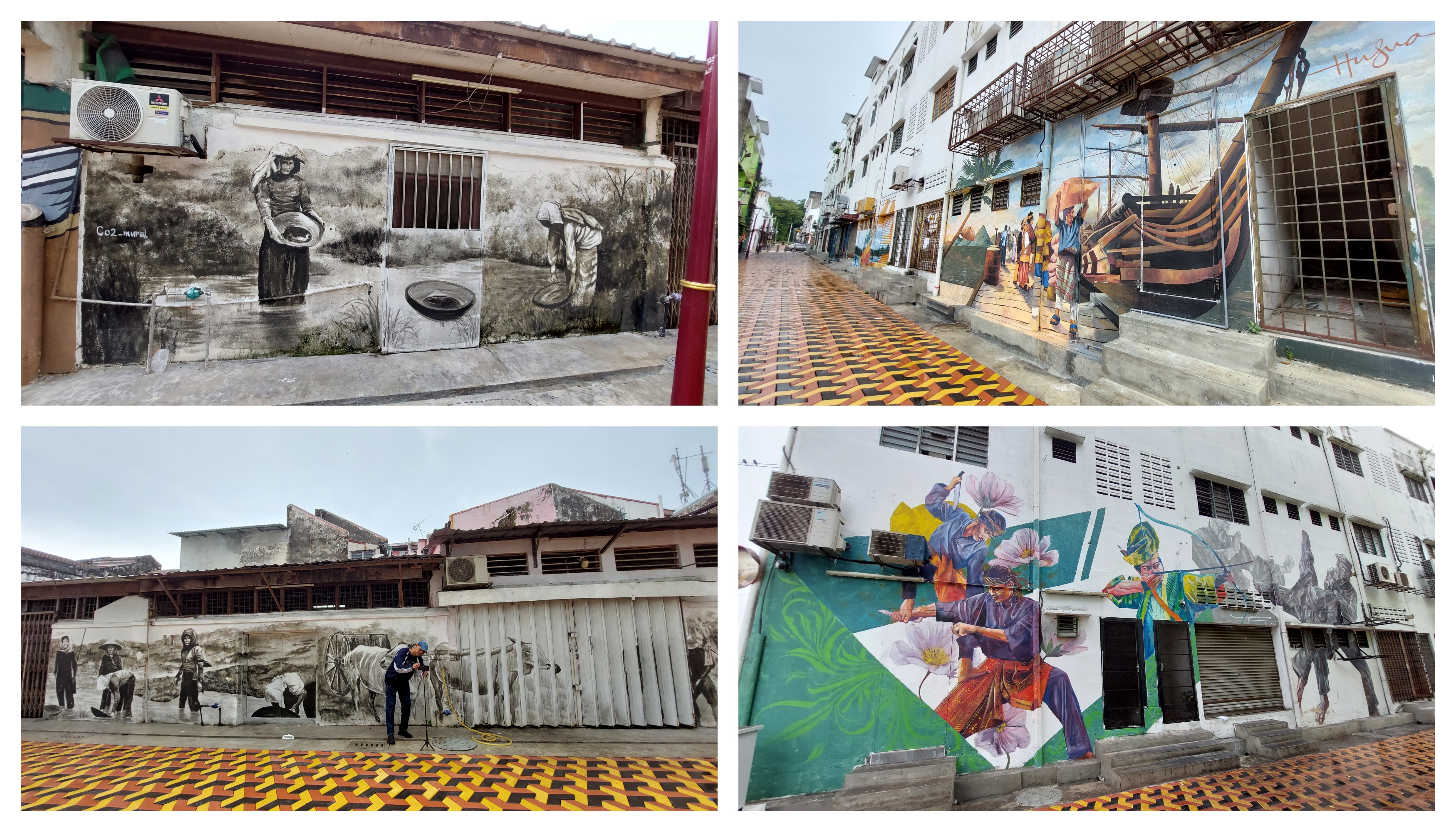
The Laluan Seni Pekan Lama Kuala Selangor is located across Masjid Sultan Lumu, the back alley behind the Restoran Bagan.

(Vibrant paintings on the walls)
(Exploring the back lane)

There are two main paintings that fill the walls of the building. As you enter the clean well maintained back lane, there are arts and beautiful interesting murals decorating the walls. Apart from being a tourist attraction, the murals provide insight to the beauty and culture of Kuala Selangor and its people.

(Local myths and legends)
(Each painting tells a story)
(Local scenes of Kuala Selangor)

The murals of Laluan Seni Pekan Lama were contributed by local artists and have legitimate artistic merit.

(Leisure activities and pastimes hobbies)
(Kuda Kepang traditional Javanese dance)
(Kampung boys simple games)
(Local kampung scenes)
(Flying without wings)
(Blending in with the locals)

Wednesday, 14 June 2023

The Portuguese Settlement in Melaka

"History is always written by the winners. When two cultures clash, the loser is obliterated, and the winner writes the history books..." - Dan Brown

(Kampung Portugis Melaka)

The Portuguese Settlement or Kampung Portugis is an area of Ujong Pasir in Melaka Tengah District which serves as a home for the Kristang people. The Kristang people are a Malaysian ethnic group with mixed Portuguese and Malay heritage, originating from the time of the Portuguese rule in Malacca in the 16th to 17th century.
 
(The junction to the Portuguese Settlement)

In 1933, 11 hectares of land at Malacca were purchased with the purpose of creating a haven for the scattered Kristang people. The swampy land was cleared and 10 wooden houses with earth floors and attap roofs were built. Saint John's village, as that simple fishing village was originally known, soon attracted additional Kristang from other areas of Malacca, and grew to become one of Malacca's main tourist attractions, improving the standard of living of its villagers.

(Portuguese Square and Foodcourt)
(A brief description of the village)

Like many other Portuguese-speaking communities around the world, the Portuguese Settlement holds a yearly "June festival" that opens with Festa de São João on June 23 and closes with Festa de São Pedro on June 29. This festival is attended by about 100,000 visitors from Malaysia and abroad. At the festival one can hear Kristang folk songs and watch dancers in colourful costumes perform to the rhythm of branyu music. An important event in the festival is the blessing of the local fishermen's boats, specially decorated for the occasion, to assure good catch.

(Christ the Redeemer, a smaller version)

When we were in Brazil in 2017, we visited the huge statue of  Christ the Redeemer. The statue weighs 635 metric tons, and is located at the peak of the 700-metre Corcovado mountain in the Tijuca National Park overlooking the city of Rio de Janeiro. This statue is the largest Art Deco style sculpture in the world.  The statue has also become a cultural icon of both Rio de Janeiro and Brazil and was voted one of the New Seven Wonders of the World. 

Read about my travel in my blog: munmus.blogspot.com

(2017 - Rio de Janeiro, Brazil)

Tuesday, 13 June 2023

Perigi Hang Tuah, Melaka

“History is a jangle of accidents, blunders, surprises and absurdities, and so is our knowledge of it, but if we are to report it at all we must impose some order upon it...”

(Perigi Hang Tuah, Duyung Melaka)

Perigi Hang Tuah is about 2 meter-deep fresh water well, which is located in Hang Tuah Village, Kampung Duyong, Melaka. It was declared as a historical monument under the Antiquities Act on 29 September 1977.

(Kampung Duyung)
(The Perigi Hang Tuah Complex)

The well is related to the story of Hang Tuah, a leading warrior in the archipelago during the Malacca Malay Sultanate (1398 1511). Hang Tuah Yang, who was born in Kampung Jambatan Duyung, is believed to have dug this well himself for his use. Originally this well was small but over time became large and deep. This well is said to never dry up, even in the long dry season. The water is always clear and is said to have medicinal properties.

(Collecting a bottle of the well water)
(Historical description oh Hang Tuah and friends)

There is also a story that this well is where the spirit of Hang Tuah resides, which incarnated as a white crocodile, known as Buaya Putih Perigi Hang Tuah. It is said that no ordinary people can see this crocodile but only the pious could.

(A surau and a Melaka traditional house)

Wednesday, 10 May 2023

A visit to Rumah P. Ramlee...

“Life moves pretty fast. If you don’t stop and look around once in a while, you could miss it...”

(P. Ramlee was born here)

This morning, after a heavy breakfast of toasted garlic bread and Kacang Phool, we drove towards Penang town and decided to visit Rumah P. Ramlee

Rumah P. Ramlee is a museum located on Jalan P. Ramlee, formerly known as Caunterhall Road. This building is a wooden house of the famous P. Ramlee, a country artist, singer, actor, composer and also director. P. Ramlee or real name Teuku Zakaria Bin Teuku Nyak Puteh was born on 22 March 1929 in Penang.

Originally built in 1926 by his father and uncle Rejab Bin Husin, this house was renovated several times before being completely taken over by the National Archives as a continuation of the P. Ramlee Memorial project in Kuala Lumpur. The items on display there include diaries, personal memories related to his life in Penang, and also items belonging to his family.

(Scenes around the historical house)
(A typical kampung house)
(The side and front entrances)
(A large poster on the wall)
(The  bedroom and the kitchen)
(History and descriptions on the wall)
(A brief history of the house and signages)
(Cooling off on a very hot day)
(A beautiful clean compound)
(P. Ramlee was born here)