About Me

I am married to my loving husband for more than 45 years now. I am a mother to 3 beautiful children, until years ago when I lost my youngest son. Since then my life is forever altered but yet unbroken....

Wednesday, 14 June 2023

Masjid Selat Melaka - 2006

"In the middle of every difficulty lies opportunity..."

(Masjid Selat Melaka)

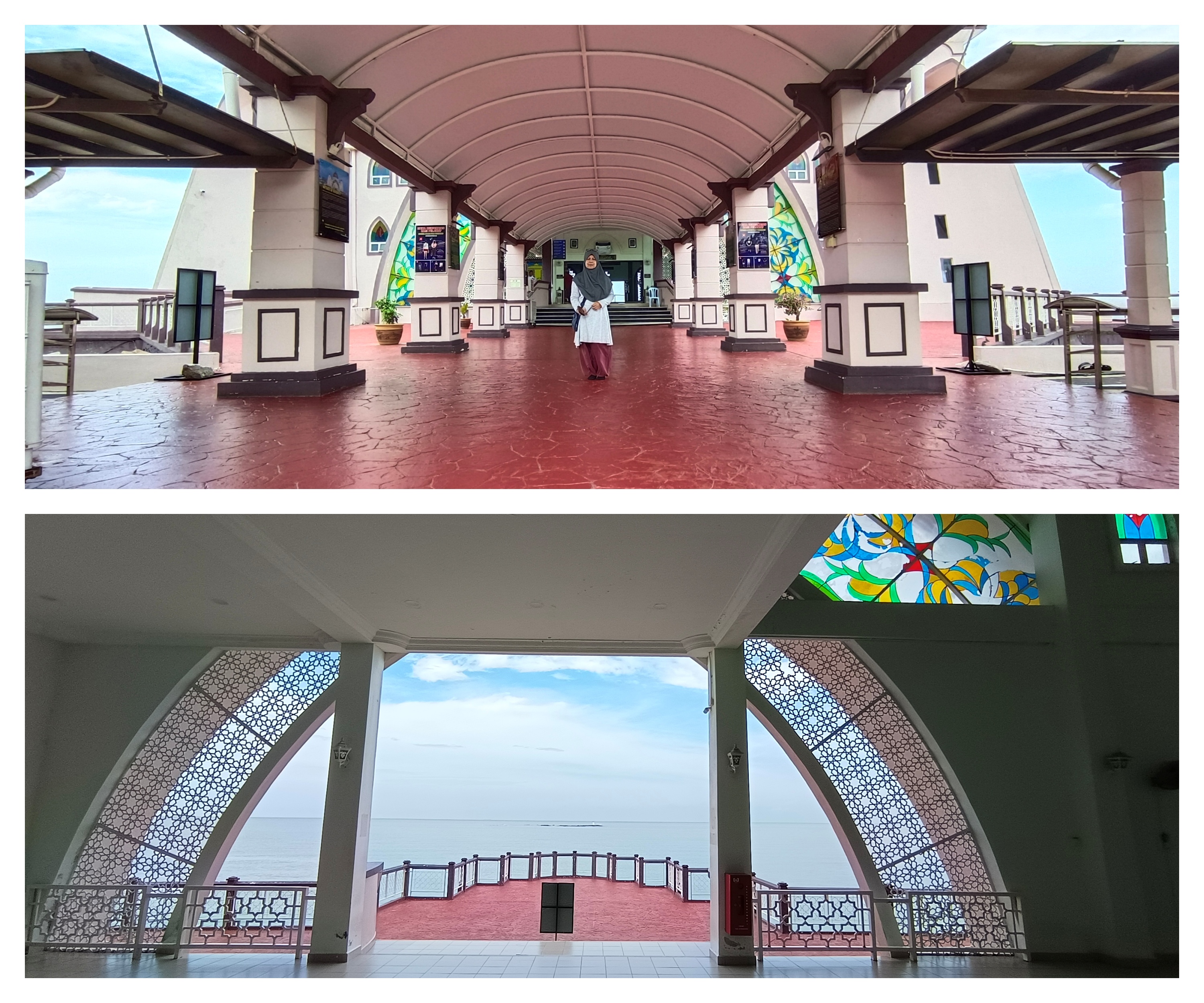
Masjid Selat Mosque is a mosque located on Pulau Melaka near Melaka City. Pulau Melaka is a man-made island that has been reclaimed. This island is located in the Straits of Malacca, because of that it is named as the Straits of Malacca Mosque. It looks like a floating structure if the water level is high.

(A mosque on reclaimed land)
(A beutiful unique architecture)

Originally, in the area of ​​Pulau Melaka there was a small island known as Pulau Jawa. Pulau Jawa has existed since the time of the Melaka Malay Sultanate. There is a record stating that ships anchored at Pulau Jawa before entering the port of Melaka. The Straits of Malacca is the longest and busiest strait in the world. It is a strait that connects the sea route between the Eastern and Western worlds. From the shore of the Straits of Malacca, you can clearly observe the trading ships passing through this strait.

(Spacious corridor and wide entrances)
(The main prayer hall)
(A huge central dome intricately decorated)

Masjid Selat Melaka can accommodate about 2,000 worshipers at any one time. It was fully completed in August 2006 and was inaugurated by the then Yang di-Pertuan Agong, Tuanku Syed Sirajuddin Ibni Al-Marhum Tuanku Syed Putra Jamalullail on 24 November 2006.

(Overlooking the Straits of Malacca)
(One of Melaka's tourist attractions)

Masjid Selat Melaka is a rather unique mosque in terms of architecture and location. Because of that, many tourists from abroad come to visit this mosque. Masjid Selat Melaka is also a good site for photography enthusiasts to capture photos of the beautiful sunset.

(The longest and busiest straits in the world)

Masjid Tengkera Melaka - 1728

"Acceptance and tolerance and forgiveness, those are life-altering lessons..." - Jessica Lange

(Masjid Tengkera Melaka)

Masjid Tengkera is a mosque located in Tengkera in the Melaka Tengah district. The name Tengkera comes from the Portuguese word tranquerah which means fortress. It was built in 1728 by a merchant and scholar from India, Muhammad Salleh and is a historic mosque because it was built during the Dutch rule. This mosque is also the second oldest mosque in Malaysia after Kampung Hulu Mosque in Malacca.

(The mosque was built during the Dutch occupation)
(Intricately carved entrances)
(The attractive main prayer hall)

The uniqueness of the design of Masjid Tengkera proves that Islam has been established in Melaka since 600 years ago. Originally, this mosque was made of wood with a roof made of nipah leaves and pillars made of belian or ulin wood imported from Kalimantan, Indonesia. This mosque was renovated twice in 1890 and 1910.

(The unique golden mimbar)
(Abolution kolah was as big as a swimming pool)

Inside the mosque area is the tomb of Sultan Hussein Muazzam Shah from Johor who had witnessed the initial agreement of handing over of Singapore to Sir Stamford Raffles with Temenggong Abdul Rahman in February 1819. After the surrender of Singapore, the Sultan left Singapore and moved to Melaka. Sultan Hussein Muazzam Shah died on September 5, 1835 and was buried in the grounds of this mosque.

(The beauty of an old mosque)
(The history of the mosque)

Tuesday, 13 June 2023

Masjid Al-Hamideen Bukit China, Melaka - 1865

"Be careful with your words. Once they are said, they can be forgiven, not forgotten..."

(Masjid Al-Hamideen Bukit China, Melaka)

Masjid Kampung Bukit China, also known as Masjid Al-Hamideen is a mosque located in Bukit China, Melaka Tengah. Bukit Cina is the largest and oldest burial ground of Melaka’s Chinese community outside of China with over 12,500 graves. The cemetery stretches over 3 hills and also includes 20 Muslim tombs.

Masjid Kampung Bukit Cina was built in 1865 from public donations and renovation and expansion were carried out in 1978. The uniqueness of this mosque lies in the shape of the roof and its architecture which resembles most of the earliest mosques in Melaka.

(Unique roof architectural design)

A note written in Jawi on the wood engraving of the door of the 160-year-old mosque confirms that the house of worship was built as a result of the mutual cooperation of the residents, thus revealing the history of its construction. In fact, the meaning of the verses clearly emphasize the spirit of cooperation and the love of religion and God.

"1861 (12 Ramadan hari Isnin) dewasa ini ada menyatakan zaman penghulu Haji Hasan Abd Rahman, berkampung muafakat sekalian orang tua-tua segala anak buah mendirikan satu masjid tempat sekalian hamba Allah SWT berhenti sembahyang di dalam kampung Bukit Antahi."

The writing on the wood engraving is still in good condition and clear and a proof that Masjid Kampung Bukit Cina was built in 1861. This mosque was built with a mixture of stone and belian wood and still retains its original features. Some renovation works were carried out to ensure that this mosque remains strong. The pillars, walls, stones and mimbar of the mosque retain the original materials. This mosque still keeps the old bedok and ketuk-ketuk that are used to determine the time for prayer, breaking of fast, as well as if there is a death among the residents. The attic of the mosque is also still in good condition. The door of the mosque that was built using belian wood is also still strong.

(The mosque interior)
(The mimbar and the main prayer hall)

In the olden days, there were many residences in the area of Bukit Cina Luar and Dalam, Lorong Bukit Cina, Bunga Raya Pantai and Jalan Bukit Cina. However, aggressive development has resulted in only about 40 homes remaining in the village. However, there are still many jemaah for Friday prayers because the village is located within the Melaka City area.

The original well of this mosque still remains. It will be used if the village area and Melaka City have water problems. The water crisis in 1990 made the well the focus of the public for water supply because it never ran dry.

(Metro 30/4/2021)

Masjid Kampung Hulu, Melaka - 1728

"Respect is not something that you can ask for, buy or borrow. Respect is what you earn from each person no matter their background or status..."

(Masjid Kampung Hulu, Melaka)

Masjid Kampung Hulu is located in the center of Bandar Hilir Melaka. Built in 1728, the Masjid Kampung Hulu is the third oldest mosque in Peninsular Malaysia that is still in use and is on its original site. This mosque is located at the intersection of Jalan Kampung Hulu and Jalan Masjid in Melaka, in an area that is now filled with shops run by Chinese traders.

(A pit stop for Bikers gang in Kembara 44 Masjid)
(A beautifully designed mosque)

This mosque was built by the local residents with Dutch funding during the colonization of Melaka by the Dutch East India Company. This mosque was built as a result of a policy change by the Dutch government, which stated the policy of religious diversity. Before the arrival of the Dutch in 1624, the Portuguese colonists had come since 1511, destroying the remains of non-Christian houses of worship in Melaka. Among those destroyed by the Portuguese was the first mosque built, which is said to be located opposite the current site of Stadhuys.
 
(The historical graveyards)

The Dutch government has assigned Kapitan to lead the local people in the construction of their place of worship. Dato' Samsuddin Bin Arom, an immigrant from China who has converted to Islam, was assigned by the Dutch government to build the Kampung Hulu Mosque. The original construction was later improved by Sheikh Al Omar bin Hussain Al-Attas.

(Claimed to be the 3rd oldest mosque in Malaysia)

The Dutch colonizers also encouraged cultural diversity among the population, and features of mosque design from Java were incorporated into the design of the Kampung Hulu Mosque. This mosque has a three-layered roof, shaped like a limas (pyramid). The space between the roof layers allows air circulation and light to enter the mosque.

(The interior of the mosque)

The roof structure is supported by four parallel pillars in the middle of the mosque, which then lead to other supporting pillars. Although the design of this mosque is influenced by Javanese design, the Kampung Hulu Mosque is not made of wood like mosques in Java, but instead is made using bricks and stones. This mosque also has a low wall that fences the mosque area.

(The main prayer area)

Like many mosques built in Malacca at that time, decorations with Chinese influences were used to decorate this mosque. Materials such as ceramic tiles and floor tiles from the Ching Dynasty were also used. Motifs decorate the edge of the dome of the mosque. The stone towers show the characteristics of Melaka design at that time, and were influenced by Chinese pagoda designs. The carvings and architecture of the mosque use natural factors. The influence of plants becomes the main criterion of architecture and carvings on the walls and roofs of the mosques. At the end of the roof there are carvings with the concept of tendrils, crowns and clouds.

(Ablution pool and the historical cannon)

This mosque is among 777 historical buildings listed by Archnet. This mosque underwent renovation works from 2010 to 2014. The original structure was still maintained.

Masjid Kampung Keling, Melaka – 1748

"Positive criticism is a good friend. Insincere flattery is a fake friend..." - Dr TP Chin

(Masjid Kampung Keling, Melaka)

Masjid Kampung Keling Mosque is located in the Melaka Tengah district. The is one of the oldest mosques in Malaysia. Built in 1748, this mosque is located on Jalan Hang Lekiu, at the intersection of Jalan Tanjong. This area is filled with Chinese business shops. At the time this mosque was built, the area around this mosque was inhabited by people from the southern part of India, and these people were called ‘Keling’ from the word Kalinga.

(Murals on the wall along Jalan Hang Lekiu)
(A brief description of the historical mosque)
(The stone pagoda minaret)

The double style in mosque design symbolizes the rapid development of architectural knowledge in Melaka at that time, with the arrival of architectural influences brought by the Dutch from Europe.

Masjid Kampung Keling was built using a square base, and not on a rectangular or hexagonal base as practiced in Middle Eastern countries. The veranda area is decorated with Corinthian columns and surround the prayer hall area. Corinthian columns also mark the separation between the mimbar space and the prayer hall.

(Three-layered roof and the stone minaret)
(The main entrance from the road)

A three-layer roof is used in the architecture of the Kampung Keling Mosque, just like the roof in the Kampung Hulu Mosque. This three-layer roof characterizes mosques in Melaka. The roof is supported by 4 main pillars in the middle of the mosque. These 4 columns are complemented by 8 smaller columns which are used to support the structure of the second layer and the third layer of the triple-layered roof.

The mosque tower is built of stone, and has the shape of a pagoda, also a characteristic of mosques in Melaka. Another influence was used because before the construction of Kampung Hulu Mosque and Kampung Keling Mosque, mosques built by the Malays did not use minarets. In 1868, the mosque and minaret were protected by a high wall as a safety separation from the road.

(Original pillars and columns of the mosque)

Ceramic tiles imported from China decorate the roof, floor and walls of this mosque. The decorative motifs that decorate the doors, windows and also the decoration on the edge of the roof are also influenced by Chinese decoration. The influence of European architecture is included in the construction of this mosque, especially with the plaster used for the interior walls of this mosque.