About Me

I am married to my loving husband for more than 45 years now. I am a mother to 3 beautiful children, until years ago when I lost my youngest son. Since then my life is forever altered but yet unbroken....
Showing posts with label Negeri Sembilan. Show all posts

Tuesday, 10 March 2026

Kembara Ramadhan 2026 – Day 01: Tracing Light Through Seremban and Melaka...

 “In visiting the houses of Allah, perhaps we are really learning how to rebuild the house within ourselves...”

(Watching the sunset at Krubung, Melaka)

Day 01: 01 March 2026 (Sunday)
Route: Kuala Lumpur to Melaka
Hotel: MITC Hotel, Melaka


On the first day of our Kembara Ramadhan, we set out to visit four mosques across Negeri Sembilan and Melaka. Each mosque stood different in design and character, yet all shared the same quiet invitation - to pause, to reflect, to return to Allah. Four mosques. Four atmospheres. One serenity.

(Masjid Saidatina Khadijah, Seremban)

Located within the busy township of Seremban Jaya, this mosque serves as a central place of worship for the surrounding residential community. Established to meet the growing needs of the neighbourhood, it reflects the practical yet warm design typical of many Malaysian community mosques built in the late 20th and early 21st century.

Its architecture is modest, prioritising space and comfort for congregational prayers. The prayer hall is spacious and well-ventilated, creating an atmosphere of calm simplicity.

There is something deeply grounding about beginning a spiritual journey in a mosque that feels so close to everyday life - where faith and routine gently intertwine. Sometimes the most meaningful beginnings happen in the simplest spaces.

(Masjid Saidatina Aishah, Seremban)

Situated in Bandar Seremban Selatan, this mosque represents a more contemporary architectural style. Designed to serve a rapidly developing township, it features clean structural lines, bright interiors, and a layout that accommodates large congregations, especially during Ramadhan.

Like many newer mosques in Malaysia, it functions not only as a place of prayer but also as a centre for community engagement — hosting religious classes, iftar gatherings, and terawih prayers that bring together families across generations.

Standing inside, I could feel the vibrancy of a living community. The mosque did not feel static, it felt alive. Modern in structure, timeless in purpose.

(Masjid Muhamad Al-Fateh, Seremban)

This mosque is one of the architectural highlights of the Forest Heights township. Inspired by Ottoman design elements, its prominent dome and slender minaret immediately draw the eye - reminiscent of classical Turkish mosque architecture.

Named after Sultan Mehmed II (Muhammad Al-Fateh), the Ottoman ruler who conquered Constantinople in 1453, the mosque symbolically reflects strength, vision, and spiritual determination.

The landscaped surroundings add to its peaceful presence. As we stood in its courtyard, there was a sense of both grandeur and humility - grandeur in its structure, humility in the act of prayer within it. Some mosques comfort you quietly. Others inspire you to look upward. This one does both.

(Masjid Cina Melaka)

Commonly known as the Melaka Chinese Mosque, this mosque is one of the most distinctive in Malaysia. Officially opened in 2014, it was built to reflect the historical presence of the Chinese Muslim community in Melaka, a state long known as a crossroads of civilisations.

Its architecture departs from the conventional dome-and-minaret form. Instead, it features a pagoda-style minaret, curved roof ridges, and design elements inspired by traditional Chinese temples. Yet despite its cultural expression, its function and spiritual essence remain fully Islamic.

Melaka’s history as a trading port brought Arabs, Indians, Chinese, and Malays together centuries ago. This mosque stands as a modern reflection of that historical harmony - a reminder that Islam has always travelled across cultures without losing its core. With the beautiful sunset as the background, we had our iftar and performed our terawih prayers here.

(MITC Hotel, Melaka)

By the end of the day, we had travelled across towns and architectural styles, from modest community spaces to culturally symbolic landmarks. But what stayed with me was not the structures themselves. It was the stillness found inside each one.

Ramadhan slows the body through fasting, but it awakens the heart through reflection. And on this first day of Kembara Ramadhan, my heart felt gently recalibrated - one mosque at a time.

Tuesday, 7 June 2022

Negeri Sembilan State Museum

“When we strive to become better than we are, everything around us becomes better too.” — Paulo Coelho

(Minangkabau design museum)

Negeri Sembilan State Museum is located at the Crafts & Cultural Handicraft Complex along Jalan Sungai Ujong, Seremban within the vicinity of the State Mosque and Seremban Railway Station. The museum building was built using the Minangkabau architecture.

(Learning about Negeri Sembilan's history)
(Malay traditional clothings and weaponry)
(The migration of the aborigines)
(Replica of the megalith stones)

The building known as Teratak Pepatih Building was previously used as a location for the National Al-Quran Recitation Competition. Due to its Minangkabau architecture, it was renovated and officially declared as the new location of the state museum on 14 July 1986.

(The aborigine clans of Negeri Sembilan)
(The uprising against the Portuguese)
(The Bugis Community in the state)

Historical artifacts and handicrafts exhibit filled the upper and lower galleries. While it was raining heavily outside, we spent almost an hour in the Museum.

(Historical events in Bukit Putus)
(An old bicycle on display)
(The stairs leading to the upper galleries)

Within the compound of the museum there are two interesting historical houses, Istana Ampang Tinggi and Rumah Negeri Sembilan. A limited number of visitors are allowed to enter the houses at a time.

(The view of the Museum Complex compound)
(Replica of Megalithic Stones of Pengkalan Kempas) 
(Two historical houses in the compound)

Istana Ampang Tinggi was built during the reign of Yamtuan Udin, the fifth Yang Di-Pertuan Besar at Ampang Tinggi in Kuala Pilah. The palace was built using timber joinery technique. This cengal wood structure is over a century old.

(Istana Ampang Tinggi)

Negeri Sembilan House original name was "Rumah Undang". This house was built in 1898 at Kampung air Garam in the town of Mambau and used to be the house of Tengku Saiyed Ismail. It was relocated to the present premise in the 1980s and has since being accorded the historical building status by the State Government.

(Rumah Undang Negeri Sembilan)

Sunday, 5 June 2022

Masjid Jamek Yamtuan Raden, Kuala Pilah

“Be nice to people on the way up, because you may meet them on the way down.” – Jimmy Durante

(Masjid Jamek Yamtuan Raden)

2.74292, 102.24862
2°44'34.51"N 102°14'55.03"E

After attending Pali's wedding, we drove direct to Masjid Jamek Yamtuan Raden in Kuala Pilah.

Masjid Jamek Yamtuan Raden is the main mosque in Kuala Pilah located along Jalan Dato, a short distance from the Sim Tong Chinese Temple. The mosque is a double storeys building complete with amenities. 

October 1964 was a historic day for Kuala Pilah, when the foundation stone was laid by His Highness the Yang Di Pertuan Besar of Negeri Sembilan, Tuanku Munawir Ibni Almarhum Tuanku Abdul Rahman. Construction work started in early 1965. This new mosque has taken the name Yang Di Pertuan Besar Seri Menanti, which is the fourth title in the lineage of Kings who ruled Negeri Sembilan. 

Other historic days for the people of Kuala Pilah was on 1 Syawal 1385 when they first held the Aidil Fitri Prayer at the Mosque, and held the Friday Prayer on March 4, 1966. From that year, there has been several renovations and additional infrastructure to meet the needs of the Muslim congregation.

(The main entrance to the mosque compound)
(The main prayer hall)
(High ceiling and airy)
(A large ceiling fan)
(Another prayer area)
(A gazebo for travellers to rest)
(A beautiful mosque in Kuala Pilah)
(Ample parking area around the mosque)
(Strategically located in town)

Wednesday, 30 March 2022

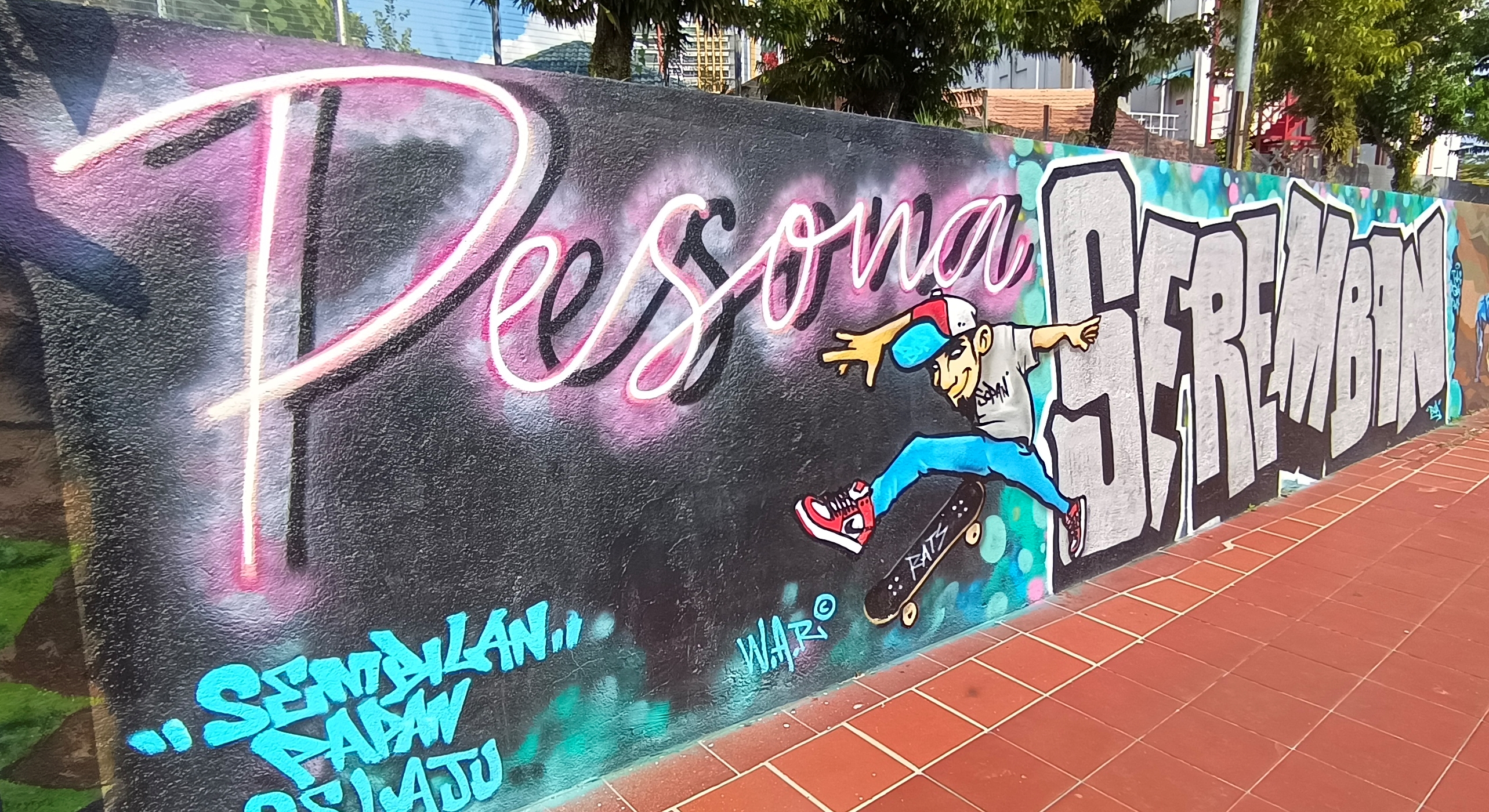
Seremban Street Arts...

“Your work is going to fill a large part of your life, and the only way to be truly satisfied is to do what you believe is great work...” - Steve Jobs

(Murals on the wall along Jalan Yam Tuan)

In conjunction with the Visit Malaysia Year 2020, several locations in downtown Seremban were decorated with murals. The street murals are located in Jalan Dato Bandar Tunggal, Jalan Yam Tuan, Jalan Tuanku Munawir up to Benteng Walk Seremban.

Unfortunately, because of the Covid19 pandemic and the MCO, we did not manage to visit these colourful sites. Recently, after completing our business at the lawyer's office we stopped along Jalan Yam Tuan and managed to capture some of the murals.

Next time we are in Seremban, we sure will find time to visit the other sites. 

(The starting point)

Tuesday, 8 March 2022

Masjid Lama kg. kuala Serdang, Negeri Sembilan – 1902

"Care will be in the heart and not in the words. Anger will be in words and not in the heart..."

(Masjid Lama Kampung Kuala Serdang)

GPS: 2.747252 102.193080
02°44′50.11″N 102°11′35.09″E

We drove leisurely on a scenic route from Rembau to Kuala Pilah via Bukit Miku. Bukit Miku is one of the steepest hills in Malaysia and a favorite route for cyclists to test their endurance. Bukit Miku is often selected as event location for the Cyclist Challenge.

(A large stone marking the summit)
(A favorite cyclists route)
(Watch out for the  right junctions)

Masjid Lama Kampung Kuala Serdang is located in Tanjong Ipoh, Kuala Pilah, Negeri Sembilan. This mosque is the oldest mosque in Tanjong Ipoh. The craftsman who built this mosque is said to be from Pagaruyung, Sumatra. The mosque was built in 1902 and fully inaugurated in 1908.

(One of the many National Heritage buildings)
(The mosque with aesthetic and cultural history)
(Preserved for our future generation)

The location of the mosque is quite remote and difficult to locate using the GPS coordinates. On the Jalan Tanjong Ipoh – Ranjau Hantu where the Google map points to the location of Masjid Lama Kampung Serdang, there is a small junction with a signage of Jalan Kg. Kuala Serdang. This small road leads downhill towards the valley where the old mosque is located. It is built on a higher ground near the banks of Sungai Muar. A newer mosque, Masjid Kariah Kuala Serdang is located just across the bridge crossing the Sungai Muar.

(Rehabilitating the old mosque to its original appearance)
(An insight into the history of our states)

The wooden Masjid Lama Kg Kuala Serdang has 20 pillars and is equipped with windows and many wind inserts (sisipan angin) for ventilation purposes. The construction of the roof of this mosque is a two-tier type with a small dome at the top. The mosque is believed to retain all the original structures without any additions from the original design. The walls of this mosque have a beautiful arrangement of wooden grilles and boards alternating with the windows. The mihrab of this mosque stands out in front showing the structure of the Minang roof. There is a stone staircase leading to the main entrance. The mosque does not have a porch.

(The posterior view of the mosque)
(Using a more durable roofing)
(A two-tiered roofing with a mini dome)
(The mosque is gated but not fenced-up)
(Criss-crossed sisipan angin used for walls) 
(Signage by the one and only door)
(Wooden flooring of the payer hall)

Although the mosque has reached the age of 120 years old, the structure of this mosque is still in good condition and well preserved. It has become one of a heritage building of Negeri Sembilan.

(The newer Masjid Kg Kuala Serdang across the road)
(A bridge crossing to the new mosque) 
(The gate is closed)
(Sungai Muar)
(Masjid Lama Kg Kuala Serdang is on higher ground)